
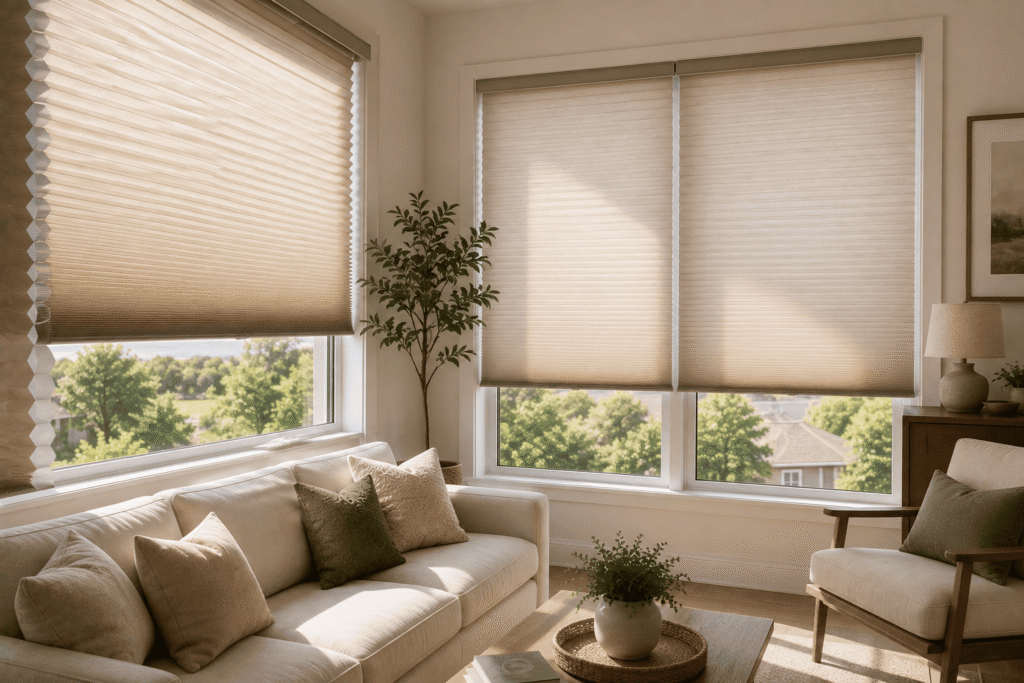
North Texas summers put real strain on home cooling costs, and windows are one of the biggest sources of unwanted heat gain. Honeycomb shades — also called cellular shades — are specifically designed to address this, and understanding how they work explains why they’re often recommended for energy efficiency over standard blinds or shades.
The Honeycomb Structure Explained
Unlike flat fabric shades or slatted blinds, honeycomb shades are made of a pleated material formed into hexagonal (honeycomb-shaped) cells when viewed from the side. These cells trap a layer of air between the shade and the window, creating an insulating barrier similar in principle to double-pane glass — it’s the trapped air, not just the fabric itself, that provides the insulating effect.
Why This Matters in Summer
In peak Texas summer heat, a significant amount of a home’s cooling load comes from solar heat gain through windows. The insulating air pocket in honeycomb shades reduces how much of that heat transfers into the room, meaning your air conditioning doesn’t have to work as hard to maintain a comfortable temperature, particularly in west- and south-facing rooms that get the most direct sun.
Winter Benefits Too
The same insulating principle works in reverse during colder months, helping retain indoor heat and reduce heat loss through the glass. While North Texas winters are milder than in northern states, the insulating effect still contributes to more consistent indoor temperatures and reduced heating costs during cold snaps.
Single Cell vs. Double Cell
Honeycomb shades come in single-cell and double-cell (sometimes called double-honeycomb) constructions. Double-cell shades have two rows of pockets rather than one, providing a measurably higher insulating value at a moderately higher cost. For west-facing rooms or homes with particularly high cooling bills, double-cell is generally worth the upgrade.
Light Filtering vs. Blackout Options
Honeycomb shades are available in light-filtering fabrics, which allow diffused natural light while still insulating, and blackout fabrics, which block nearly all incoming light in addition to providing the insulating benefit — useful for bedrooms or media rooms where both temperature control and darkness matter.
Where They Make the Biggest Difference
Rooms with large windows, west or south exposure, or older single-pane glass see the most noticeable benefit, since these are the areas losing or gaining the most heat through the window itself. Smaller or already well-shaded windows will still benefit, but the impact is naturally less dramatic.
Cordless and Motorized Options
Like most modern window treatments, honeycomb shades are widely available in cordless and motorized versions, so the safety and convenience benefits discussed for other product types apply here as well — you’re not trading energy efficiency for a corded mechanism.
A Practical Add-On to Existing Efficiency Upgrades
Honeycomb shades work well alongside other energy-efficiency measures like attic insulation or energy-efficient glass, rather than replacing the need for them — they’re most effective as one part of an overall approach to reducing a home’s cooling and heating load.
If you’re dealing with rooms that consistently run hotter than the rest of the house, it’s worth having us take a look at which windows are contributing most, and where double-cell honeycomb shades would make the clearest difference.