
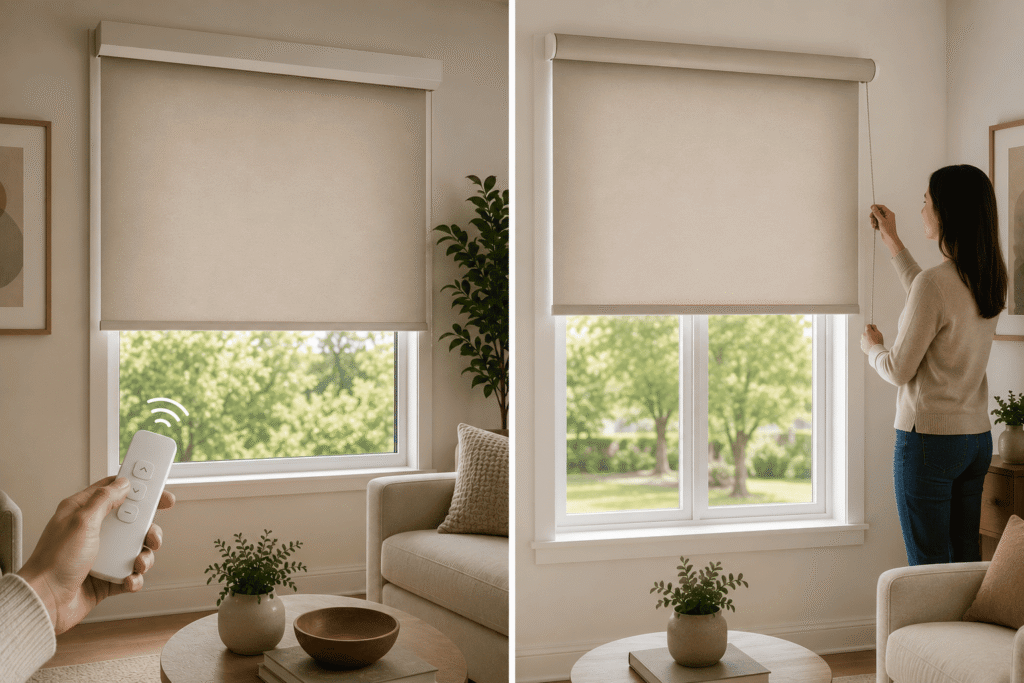
Roller shades are one of the most versatile window treatment options, and the choice between manual and motorized operation comes down to more than just convenience — it affects cost, installation, and how well the shades fit into daily routines. Here’s how to think through the decision.
How Manual Roller Shades Work
Manual roller shades operate with a spring-loaded or chain-driven mechanism, raised and lowered by hand. They’re simple, reliable, and require no batteries, wiring, or app setup — the mechanism is entirely self-contained within the roller itself, which also makes them the more affordable and lower-maintenance option long-term.
How Motorized Roller Shades Work
Motorized versions use a small motor built into the roller tube, controlled via a remote, a wall switch, a smartphone app, or, in some cases, a voice assistant integration. Power comes from either a rechargeable battery pack (recharged periodically via a cord or small solar panel) or, less commonly, a hardwired connection run during installation.
Where Motorized Shades Genuinely Add Value
Motorization is most valuable for windows that are hard to reach physically — high or oddly placed windows, skylights, or shades positioned behind furniture. It’s also useful for homeowners who want scheduled operation, such as shades that automatically close in the late afternoon to reduce heat gain, or open in the morning without anyone needing to be home.
Where Manual Shades Are the More Practical Choice
For easily accessible, standard-height windows, manual shades accomplish the same light and privacy control without the added cost, batteries, or occasional troubleshooting that comes with any motorized system. If budget is a primary concern, or you’re outfitting many windows at once, manual remains the more cost-effective choice across the board.
Cost Differences
Motorized roller shades cost more per window than manual versions, reflecting the motor, control system, and sometimes additional wiring involved. The gap has narrowed as motorization technology has become more common, but it remains a meaningful cost difference, particularly across a whole-home installation.
Battery Life and Maintenance Considerations
Battery-powered motorized shades typically need recharging every few months depending on usage frequency, which is a small but real maintenance task that manual shades don’t require at all. This is worth factoring in for homeowners who prefer a fully “set and forget” solution.
Smart Home Integration
If you already use a smart home system, motorized shades can often be grouped with lighting, thermostats, or other automated devices, allowing shades to respond to schedules, sunset/sunrise times, or voice commands alongside your existing setup. This integration is one of the strongest arguments for motorization if smart-home use is already part of your routine.
A Mixed Approach Is Common
Many homeowners choose motorized shades selectively — for hard-to-reach or frequently adjusted windows — while keeping manual shades in easily accessible rooms like bedrooms or home offices. This isn’t an all-or-nothing decision, and mixing both within the same home is a practical way to manage cost while still getting the convenience where it matters most.
Making the Right Call for Your Home
The right choice depends less on preference for technology and more on which windows you’re actually treating and how you use each room. A hard-to-reach living room window and an easily accessible bedroom window don’t need the same solution.
If you’re not sure which of your windows would benefit most from motorization, we can walk through your home and point out exactly where it makes practical sense versus where manual is the smarter, more cost-effective choice.